
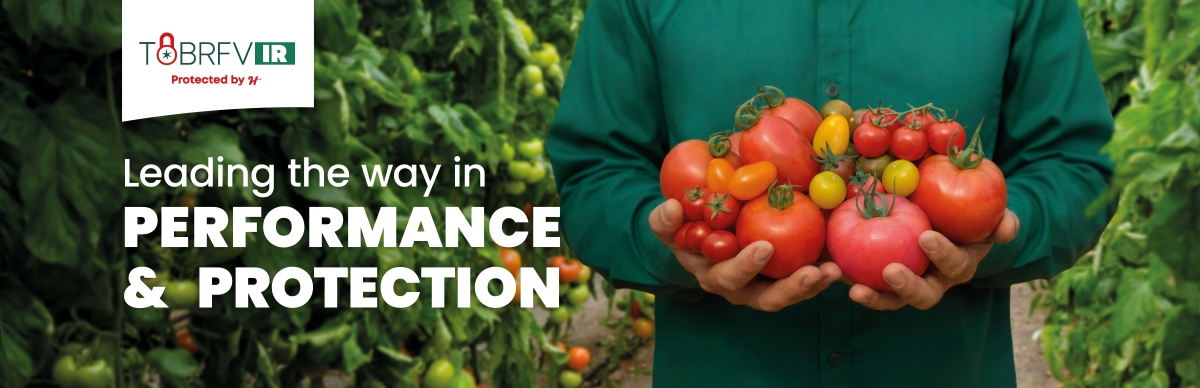
Leading the Way in Performance and Protection

ToBRFV resistant varieties are now widely expected across the industry, but protection alone is not enough to secure a successful crop.

At Hazera, we believe growers do not have to choose between resilience and results. Tomato varieties must combine healthy plant growth, high and consistent yields, uniform and market-quality fruit, strong agronomic stability, and excellent shelf life, performing constantly and reliably season after season under changing production conditions.

This belief is the foundation of Hazera’s ToBRFV-resistant tomato portfolio, where performance drives protection. From the earliest days of the ToBRFV challenge, Hazera has invested in breeding solutions that combine high agronomic performance with effective resistance, pioneering an approach centered on the balance between performance and protection. Today, that long-term vision is expressed in a diverse, evolving portfolio built for real-world growing environments.

Hazera’s ToBRFV portfolio includes a broad and continuously expanding range of varieties and tomato typologies based on some of our well-performing varieties without resistance, bringing the traits growers know and trust together with the added protection they need.

In the mini plum segment, new varieties such as Nemeton and Draconor complement established types like Pendragon and Windsor, all of them part of the “Tomatoes that work for you” concept offering “less labor, less waste, more quality” through improved resistance, high yield, uniform fruits, long shelf life, and strong plant vigor, making them ideal for snack tomatoes and versatile market uses.

In the yellow cherry segment, Summer Cool and Summer Soul deliver bright color, premium eating quality, high yield, and consistent fruit size, meeting the growing demand for vibrant, flavorful cherry tomatoesa and broadening the options available to growers and retailers alike.

Building on our trusted heritage varieties, Maggie Pro extends the well-known Maggie program with added ToBRFV resistance, maintaining the taste profile, market appeal, and reliable performance growers have relied on for years. Other examples include Feelotimo, and Donneluce, both beef types, Montefiore, cherry round cluster type; and Pinknova, pink tomato, each combining the strengths of their classic predecessors with virus protection.

As the needs of growers continue to evolve, Hazera remains focused on delivering tomato varieties that bring together great performance and strong protection. Through ongoing breeding innovation and a strong pipeline of future introductions, Hazera is committed to helping growers move forward with confidence; today, tomorrow, and in the seasons ahead.

Press Release: IR ToBRFV varieties in pipeline

Press release
August 2022

Hazera announces varieties with intermediate resistance (IR) to Tomato Brown Rugose Fruit Virus (ToBRFV) in pipeline

Hazera is proud to announce the launch of our ToBRFV intermediate resistant varieties- the optimal balance between protection and performance– providing the grower an effective tool to face the highly infectious virus, infecting tomato plants, fruit and affecting growers worldwide. The Tomato Brown Rugose Fruit Virus poses a constant threat to growers worldwide, significantly reducing yields, affecting the quality of fruit, and systematically infecting other plants, as it is a very transmittable virus that can infect through soil, tools, water, and people’s contact.

Since ToBRFV hit, Hazera’s R&D team has been working tirelessly to find varieties capable of giving an effective level of ToBRFV resistance without compromising the yield and fruit quality we’ve invested years to perfect. Over the course of several years, Hazera researchers and agronomists invested endless resources to find solutions to address our growers’ needs worldwide. Moreover, according to Alejandro Szechtman, Hazera’s Portfolio Marketing Director, “These efforts included in-depth trials in many locations, under different conditions in a global scale, to confirm that we are able to provide the optimal solutions, with the right balance between performance and ToBRFV protection”.

Hazera is proud to announce a wide ToBRFV resistant variety pipeline worldwide, with which we will be able to tailor-make the optimal solution per market requirement, beginning with Italy, Greece, Spain, Mexico, Turkey, Israel etc’.

Hazera, through Limagrain’s upstream research, contributed to a network of internal and external collaborative discovery projects on ToBRFV using different approaches. This resulted in Limagrain being the first company to file a patent on ToBRFV resistance in tomato in 2017. While the first generation of tomato hybrids resistant to ToBRFV is being commercialized, Limagrain discovery programs continue to work intensively to find resistances against potential emergent more aggressive forms of this devastating virus.

“Our R&D efforts haven’t ended, we’re still investing to achieve higher resistance, and expand our portfolio to the benefit of growers worldwide,” said Szechtman.

Hazera is a global leader in the seed industry. Hazera has headquarters in both the Netherlands and Israel. We operate subsidiaries in 11 countries, together with a distribution network serving over 130 markets. Our partners operate in all kinds of climates, and under diverse growing conditions and market requirements. For over a century, our top priority has been walking alongside them, developing an enormous variety of seeds and providing comprehensive support every step of the way. Hazera’s team of experts works directly with growers to evaluate their needs, assist during variety selection and provide guidance and support throughout the crop cycle.

Hazera is part of the Limagrain Group, an international agri-business based in France. Being a farmers’ cooperative, the Limagrain Group understands the needs of its customers and has grown to become the largest seed company in Europe, specialising in vegetables, field crops and cereal products. Limagrain’s vegetable seed division is the second largest company in the industry.

ToBRFV in Tomato Plants

by Dr. Yaniv Rotem – Solanaceae Pathologist, Hazera


General background

The Tomato Brown Rugose Fruit Virus – ToBRFV – is a relatively new viral disease, first appearing in the Middle East in 2014. The disease has since spread rapidly to many other areas in the world, and currently constitutes a major global problem in tomato crop production worldwide.

In Israel, all tomato production areas have been severely affected by ToBRFV, and the effects of the disease are evident both in the tomato greenhouses and fields, and in the quality and appearance of the fruits which are sold.


Symptoms of the disease

As a rule, the symptoms of the disease are similar to the typical symptoms of ToMV, but the severity of the symptoms can differ from that known with ToMV:

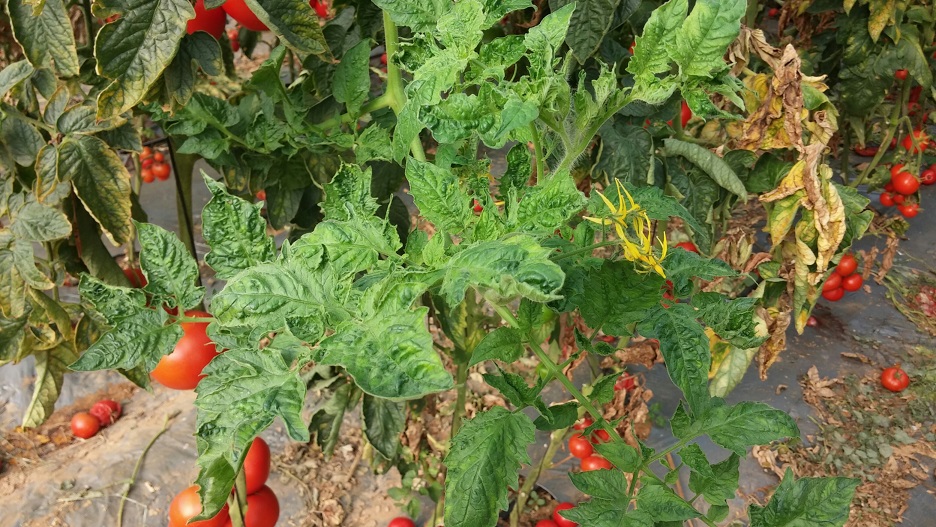
  • In the leaves – a mosaic appears, which is particularly noticeable on young leaves and at the growth vertices. In some cases, there is narrowing of the leaflet blade, and in certain cases the leaves become entirely threadlike (“shoestrings”).
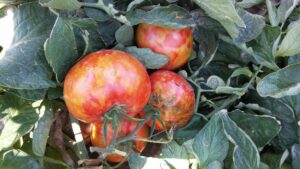
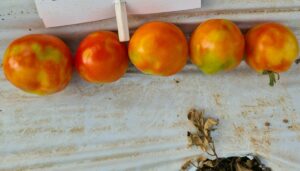
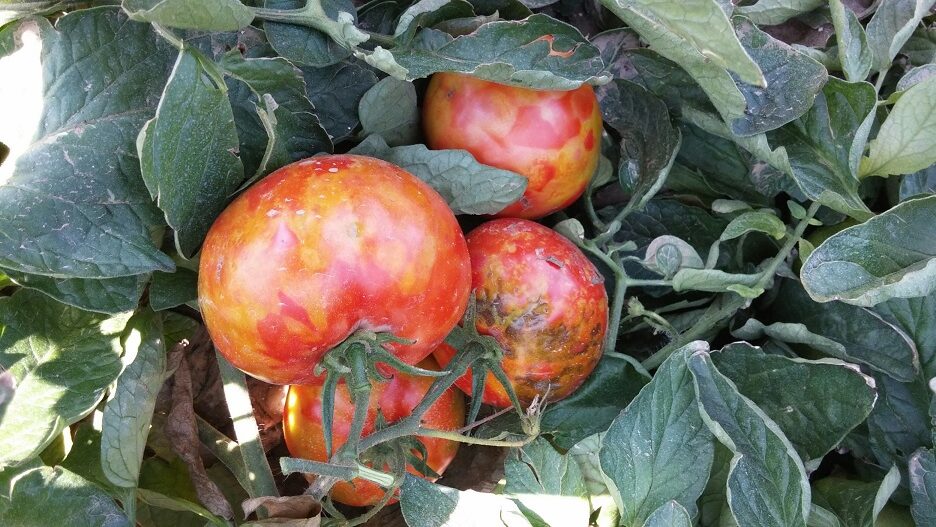
  • In the fruit – yellow spots develop which become necrotic at a later stage. In some cases, “chocolate spots” appear on the fruit. In cases of severe damage, the fruit becomes wrinkled and distorted. The virus name (“Brown Rugose Fruit”) was given due to the wrinkled appearance together with the brown spots.
  • Note that in contrast to the characteristic situation when affected by ToMV, in which symptoms generally appear in the fruit only in cases of particularly severe damage to the foliage, in the case of ToBRFV – there is no connection between the severity of damage to the fruit and severity of damage to the foliage: there are situations in which serious damage to the fruit is observed while no symptoms appear on the leaves, or vice versa – cases of severe symptoms in the foliage and lack of symptoms in the fruit.
  • In certain cases – necrosis develops of the calyx of the fruit, the fruit peduncle, and the central spine of the cluster of fruit.
  • When a susceptible variety is infected with ToBRFV, the main damage is a significant weakening of the plant and its capability to produce clusters of fruits over a long season.

In the wake of the viral infection, tomato cultivation in Israel has changed entirely: due to the weakening of the plants, growers currently have almost no possibility to grow tomatoes in a long central season of 9-10 months as was customary before the virus’s appearance; instead, shorter growing seasons of 4-5 months are now customary, intended for harvesting a few clusters only.


Symptoms on leaves – severe mosaic and narrowing of some of the leaf lobes, to the point of appearing “thready”


Severe symptoms in the fruits

Symptoms of necrosis in the calyx, fruit peduncle and the spine of the cluster

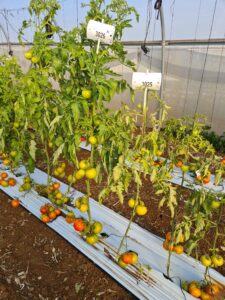
Weakening of the plant as a result of viral infection in a susceptible variety (on right) compared to a variety that is largely similar to it but is resistant to the virus (on left).


How is the disease transmitted?

  • ToBRFV is very easily transmitted mechanically – by human contact, by work tools, support wires, or any entity that comes in physical contact with an infected plant or soil that contains the virus and later comes in contact with healthy plants. It is important to remember that particles of this virus are particularly resistant to environmental conditions, and are capable of surviving for long periods in soil or on infected surfaces.
  • Since the virus is capable of surviving in soil for a long period – the virus is also transferred with infected soil that is moved from one place to another (by sticking to shoes, to work tools that are moved from one plot to another, etc.).
  • The virus is transmitted in seeds – a seed produced from an infected plant is likely to carry virus particles on its surface.
  • The virus can also be transmitted by bumble bees, which serve to pollinate during the cultivation process.


Prevention and treatment

  • Since the outbreak of the disease, Hazera together with Limagrain Group have been working on a comprehensive study of the issue, in which tomato varieties with intermediate levels of resistance to the virus were developed. The first patent in the world for resistance to ToBRFV was registered by Limagrain in 2017. Using these varieties provides an optimal solution for growing tomatoes in conditions of infections with ToBRFV, while maintaining the varieties performance.
  • Observing phytosanitary rules is key to preventing the disease:
    • Making sure to have clean clothes, jackets and gloves for those entering the greenhouses.
    • Making sure to sterilize all equipment used.
    • Sterilizing shoes in an immersion pit upon entrance to the greenhouse.
    • Being strict about the order in which buildings are entered – the workday begins with the buildings housing the young, healthy plants and continues to the buildings housing the more mature plants.
  • Plants in which infection is discovered should be immediately removed from the greenhouse, being careful to avoid contact with neighboring plants.
  • Using healthy seeds and seedlings is another key to preventing the disease. Hazera is strict about performing health tests in licensed laboratories, according to international standards and the Plant Protection Services. Checking that seeds are free of ToBRFV is done by the ISHI Protocol, which is the international protocol accepted throughout the world.
  • Being strict about good sanitization – sterilizing the soil or growth medium and the greenhouse space when cultivation is completed.


Hazera’s Official Training Video: Tomato Brown Rugose Fruit Virus (ToBRFV)

We are happy to present Hazera’s training video and sanitation guide for dealing with the new ToBRFV virus.

The purpose of this video is to assist growers and farmers to gain a better understanding of the ToBRFV virus, and to share some practical advice and active measures for eradicating the growth of this virus through the use of stringent hygiene and highly effective sanitation. (more…)